The Strong People Need Safe Places Too
This past week, if you spoke to me, you likely encountered a version of Dara that was running dangerously close to empty.
Ironically, it was also one of the most beautiful weeks I have had in a long time.
There was an impromptu wedding ceremony for friends we care deeply about Wednesday. Thursday brought a last-minute request to help transport someone in need coordinated around a Women In Automotive interview where, for once, I was the one being interviewed instead of asking the questions. Then a Friday night house full of laughter, homemade pizza, games, and people whose company I genuinely enjoy.
From the outside, it looked like a full and meaningful week.
And it was.
But somewhere in the middle of all the beautiful moments were the quieter realities that were taxing every emotional, mental, and physical resource I had.
The strange thing about overwhelm is that it does not always announce itself loudly. Sometimes it slips in quietly. Sometimes it looks like oversleeping four days in a row when you are normally awake with the sunrise. Sometimes it sounds like a constant stream of “I can’t” thoughts that you have to continually fight off before they take root. Sometimes it looks like shutting down internally while doing the bare minimum necessary to convince everyone around you that you are okay.
That was me this week.
And perhaps the most humbling part of all of it is this:
I am literally the burnout coach.
I spend my days helping others identify warning signs, protect their energy, build healthier patterns, and avoid reaching the point of collapse. Yet this week I found myself having to practice every… single… thing I teach others.
Not because I had failed.
But because I, too, am human.
One of the moments that impacted me most happened during the wedding preparations. Most of the women there had only met me a few days earlier. Mat, my husband, was there to do the ceremony, he was an essential part, but up until that point, I honestly felt like an outsider simply witnessing someone else’s special moment. Then Jessica, the bride, suddenly announced to the room that I was going to help her into her wedding dress.
She did not ask.
She simply trusted me with it.
And something shifted in me that moment.
In a week where I quietly felt disconnected and emotionally withdrawn, this woman looked at me and let me know I belonged there. I was not just a spectator, the Pastor’s wife, but a trusted friend invited into something sacred.
I do not think she realized how much that meant to me.
Then a moment came Friday, when Mat stepped into my office to let me know he was leaving to run errands. I stopped him and asked him to pray for me. I had just asked two of my dearest friends to do just the same, letting them know how on edge I was. And at first, I tried to explain what I was feeling in the calm, measured way strong people often do when they are trying not to fully unravel. But his response created safety. And in that safety, I finally let the weight I had been carrying come out.
I cried.
I admitted how overwhelmed I really was and I stopped pretending I was managing it all well.
For many people, asking for help comes naturally.
For me, it does not.
Maybe part of it is oldest-child hyper-independence. Maybe part of it comes from years of being surrounded by people who treated vulnerability as weakness. But I think another part of it comes from being the person others usually lean on.
When people regularly come to you for wisdom, strength, support, leadership, or comfort, it becomes very easy to believe your role is to reduce burdens, not add to them. You convince yourself that needing help somehow makes you less trustworthy. Less capable. Less strong.
But this week reminded me of something important:
The strong people need safe places too.
All week long, people around me noticed something before I was fully willing to admit it myself. Again and again, I heard reminders to slow down and take care of myself. Even during my interview with Martha Rader for Women In Automotive, she gently reminded me not to burn myself out while teaching others how to avoid burnout.
At some point, I realized God was speaking to me through the people around me.
Through the friends who asked if I was okay.
Through the husband who prayed for me.
Through the people who noticed the subtle shift in me before I fully acknowledged it myself.
The uncomfortable truth is that many strong people become incredibly skilled at surviving while quietly falling apart internally. We learn how to continue performing. Continue producing. Continue showing up. We learn how to smile while withdrawing emotionally. How to remain dependable while privately shutting down. How to carry overwhelming weight without letting it visibly spill onto the people around us.
And eventually, that performance becomes so normal that even we stop recognizing we are exhausted.
I think that is part of why this week affected me so deeply.
Not because I came close to burnout.
But because I realized how easily I could have continued pretending I was fine.
I could have kept answering messages.
Kept checking boxes.
Kept showing up as “the strong one.”
And most people probably would have believed me.
But somewhere between the tears in my office, the prayers of trusted friends, and the quiet conviction of the Holy Spirit, I found myself face to face with a truth that sits at the very core of my burnout framework, yet can still be difficult for me to live myself:
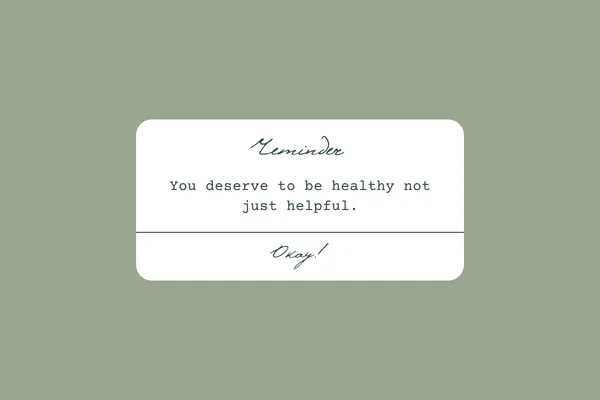
I deserve to be healthy not just helpful.
Not valuable only when I am producing.
Not worthy only when I am serving.
Not lovable only when I am carrying everyone else well.
Healthy.
Emotionally. Spiritually. Mentally. Physically.
And sometimes the greatest act of trust is allowing the people who love you to witness your humanity without rushing to hide it from them.
This week humbled me in ways I did not expect.
Not because I broke. But because I finally stopped working so hard to make sure no one saw how close I was getting. And maybe that is the real danger of burnout for high-capacity people.
Not that we collapse loudly.
But that we quietly disappear inside ourselves while continuing to function well enough that nobody realizes how much pain we are actually carrying.
Including us.

