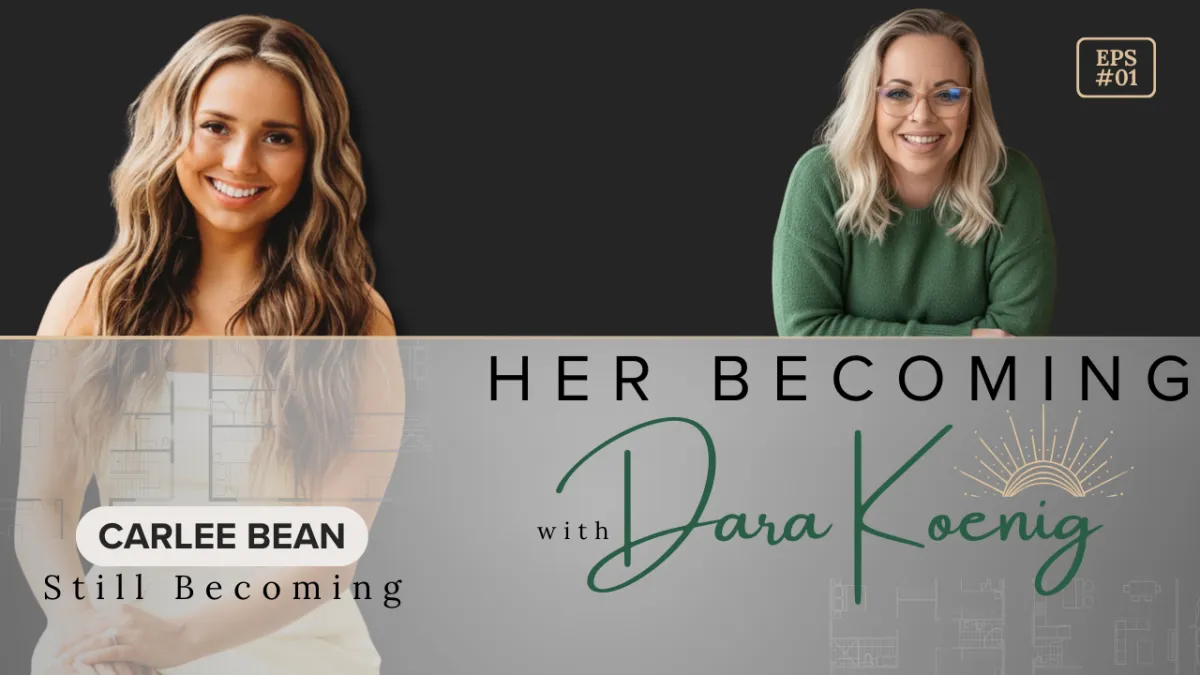
Her Becoming: Carlee Bean
She's Only 20...
I thought she was twenty-two. I was wrong, and what I found when I learned the truth changed everything about why this interview had to be the first one.
Picture a front door.
It opens, and standing on the other side is a child, eyes wide, barefoot maybe, the kind of child who still answers the door without checking first. A young woman is standing on the porch holding a box of food. It’s not a holiday. There is no occasion. It is just a Tuesday, or a Thursday, or whatever day of a school break it happens to be. A day that, for this family, would have been a hungry one.
The child looks at the box. Looks up at the young woman. And says thank you, with the full, uncomplicated sincerity of someone who has not yet learned to take things for granted, for a banana.
A single banana.
“It’s something that you honestly take for granted,” the young woman would later tell me, her voice going quiet in the way it does when a memory still has weight, “until you see a child thanking you for a banana.”
That young woman is Carlee Bean.
She is twenty years old.
“It’s not just a handout. It’s a little bit of a hand up.”
How I Found Her
I heard about Carlee before I ever met her.
She came recommended by UCDD leadership when the Foundations of Service training team I had recently built needed a new emcee. The description I received was brief but compelling: young, thriving in her role as Family Caregiver Coordinator, helps coordinate a nonprofit, and, this part landed like a headline, had just been accepted into law school. They mentioned she was young, and somewhere in the way they said it, I pictured twenty-two. Maybe twenty-three.
I didn’t find out the truth until we were sitting together for the interview. She said it so casually, the way you mention something that has simply always been true, and I felt something shift, not just surprise, but recognition. I’ve been around women long enough to know when I’m in the presence of something rare. And in that moment, I knew with absolute certainty: this was the story I had to tell first.
Because here is what I saw when Carlee told me she was twenty: I saw my daughter.
My youngest, Bella, is, at the time of this publishing, a month away from her eighteenth birthday. This spring she will walk across a graduation stage and receive not just a high school diploma, but an associate’s degree: a credential most adults don’t hold, earned before she is legally old enough to do half the things the world is about to open to her. I look at Bella the way Carlee’s parents look at Carlee: with the kind of belief that doesn’t require proof, because the proof is already standing right in front of you.
That is why I launched Her Becoming. And that is why it begins here, with Carlee. Not because her story is perfect. Because it is possible. And I want every woman who reads this, whether she is eighteen or forty-eight, whether she is building her first life or rebuilding a second one, to see herself somewhere in these pages and think: if she can, maybe I can too. Maybe my daughter can too.
Twenty and Already Building Forward
There is a particular kind of composure that takes most women decades to develop, somewhere between confidence and calm, the unruffled certainty of someone who knows exactly what she is building, and trusts that the foundation beneath her will hold.
Carlee carries it at twenty.
She is building a home with her fiancé, whom she’s marrying this June. She graduated from college early, not because the pace was easy, but because she loaded extra credit hours into every semester with the focused intention of someone who doesn’t confuse busyness with moving forward. She has been accepted into law school. And in between all of that, she shows up every day to her role at UCDD, where she helps sustain the people who hold other people’s lives together, and coordinates Food to the Rescue programming where one of her responsibilities is to personally drive boxes of food to doors where children light up like it’s Christmas when she knocks.
She listed all of this with the matter-of-fact tone of someone reading from a very well-organized planner. Which, as it turns out, she absolutely keeps.
“I work well in chaos,” she said with the ease of someone who has made genuine peace with a full life. “As long as I have my plan.”
The plan, she will be the first to tell you, is everything. The to-do lists. The time-blocked calendar. The two-week runway she builds into every deadline at UCDD so there is space left for review, for correction, for the kind of care that rushed work never allows.
The Foundation They Built
Ambition this focused doesn’t arrive from nowhere. It is cultivated, slowly and intentionally, over years of being told, and shown, that trying matters more than outcome.
Carlee’s father is a police officer. Her mother, an office manager. They are people who built their lives on the unglamorous virtues: showing up, following through, refusing to let imperfection become an excuse for inaction. Long before Carlee had a planner or a plan, she had parents who looked at her and said, in every way that counted, you can.
“They’ve always pushed me to be the best that I can be,” she said, “and to at least try new things… even if it doesn’t work out, you can say you tried.”
There is something worth sitting with in that sentence. The permission to try without the guarantee of success is one of the most quietly radical gifts a parent can give. It reframes failure not as evidence of inadequacy but as proof of courage. It teaches a child that the attempt itself carries dignity, and that belief, once rooted, has a long reach.
I thought about Bella when Carlee said that, about the years I’ve spent telling her the same thing in different words, at different kitchen tables, and the way that message compounds over time into something a young woman eventually just knows about herself. Carlee knows. You can hear it in the steadiness of how she speaks about her own life. Not with bravado. With the quiet certainty of someone who was taught, early and often, that she was worth believing in.
Woven through all of it is faith. Carlee speaks about prayer the way some people speak about oxygen, not dramatically, but as something simply necessary. It is the foundation beneath the planner, beneath the to-do lists, beneath the courage required to sit for the LSAT. It is what allows her to release the outcomes she cannot control and move boldly on the ones she can.
Moving Before She Was Ready
Carlee was nineteen years old when she sat down to take the LSAT. Yes, you read that right, she was just nineteen.
Most people who pursue law school arrive at the test after years in the workforce, after long detours through other careers, after life has had time to convince them they need a credential to anchor the next chapter. Carlee arrived having just barely been old enough to vote.
She will tell you it was terrifying. The what-ifs were real and loud. And she sat in that testing room anyway, because she has built a practice, not a habit, a practice, of moving before she feels ready.
“I think I still move during that uncomfortable space,” she said. “Because there’s always that what-if. You just have to push yourself, because there’s always a chance.”
She placed the outcome in God’s hands, not as a cliché, but as a genuine surrender of the thing she most wanted and could not guarantee. If it wasn’t the right time, she told herself, she would accept that. But it was the right time. And when the acceptance letter arrived, what she felt wasn’t jubilation.
It was relief.
“Okay,” she thought. “I got this step done. Now the next one.” She wasn’t celebrating. She was already looking forward.
“I would rather work hard now and be more smooth sailing as I get older than have to work hard when I am older.”
Eating the Frog
When I asked Carlee to picture herself at forty, she didn’t reach for a title or a milestone. She reached for a feeling.
“I hope to be strong and show my integrity and kindness,” she said. “I hope to reflect back on my twenties and say that it was hard, but that the hardness in the twenties made it easier for me.”
There is a term for this; eating the frog, doing the hardest, most demanding work first, before comfort has a chance to convince you otherwise. Carlee is doing it at twenty, compressing the sowing years and trusting that a harvest deferred is not a harvest denied.
“I would rather work hard now,” she said, with a steadiness that carries no martyrdom, “and hopefully be more smooth sailing as I get older, than have to work hard when I am older.”
The woman she is becoming at forty is being built right now, in the early mornings and loaded semesters and full-calendar weeks of twenty.
This Is What Possible Looks Like
Before we wrapped up, I asked Carlee what she would say to a young woman who knows she’s capable, who can see what she wants to build, can picture herself building it, but still finds herself standing at the edge, unable to step.
“You just have to take that step forward,” she said without hesitating. “I know it might be scary and intimidating at the time, but you’ll always get through it, especially with prayer and a good support system behind you.”
And for the woman who doesn’t have that support system? Carlee’s answer was as practical as everything else about her: start talking to whoever is sitting next to you. At her commencement, she found herself beside strangers also heading into law school. A conversation. A shared direction. A new thread of community, born from nothing more than proximity and the willingness to put the fear down long enough to say hello.
I sat with that for a long moment after our interview ended.
I thought about Bella, a month from eighteen, standing at the edge of a life that is wider and more full of possibility than she may yet understand. I thought about what it means to be seen early, to have someone look at you before the world has fully made up its mind about you and say, without reservation: I see what you’re capable of. I believe in where you’re going.
Carlee’s parents gave her that. Our series exists to give it to you.
Whether you are eighteen or forty-eight. Whether you are in the middle of something hard or standing at the start of something new. Whether you are reading this for yourself or quietly thinking about a daughter, a mentee, a young woman in your life who is closer to her potential than she knows, this story is for you.
Somewhere right now, a door is opening. A child is saying thank you for a banana. And a twenty-year-old woman is standing on that porch, building a home, planning a wedding, heading to law school, filling the cups of people who pour themselves out for others, doing the hard things now so that later carries less weight.
She is a glimpse of a future built on support and focus. She is proof that the life you want is on the other side of the step you’re afraid to take.
And she is only just beginning.
—
and Please ... Pardon Our Dust

Carlee Bean serves as Family Caregiver Coordinator at the Upper Cumberland Development District (UCDD) and coordinates Jackson County programming for Food to the Rescue. She is currently enrolled in law school and resides in the Upper Cumberland region of Tennessee.

